
Carl Jung, one of the most influential depth psychologists of the twentieth century, proposed that religious symbols often represent universal psychological patterns rather than only theological doctrines. In his work Aion: Researches into the Phenomenology of the Self, Jung explored the figure of Christ as an archetypal symbol of psychological wholeness. Rather than interpreting Christ solely as a historical or theological figure, Jung suggested that the Christ image symbolizes the Self — the integrated totality of the human psyche.
According to Jung, the Self represents the unification of conscious and unconscious elements within an individual. The journey toward this unity is what Jung called individuation — the lifelong process through which a person becomes psychologically whole. Christ, in this symbolic interpretation, represents the ideal image of this completed state of integration. The archetype captures the possibility that human beings can reconcile conflicting parts of themselves and embody a higher level of psychological alignment.
However, Jung argued that this path toward wholeness requires confronting something many people avoid: the shadow.
The Shadow: The Hidden Half of the Psyche
In Jungian psychology, the shadow refers to the aspects of the personality that individuals reject, repress, or fail to recognize in themselves. These can include traits society discourages, emotions a person finds uncomfortable, or qualities that conflict with one's self-image. Jung described the shadow as an unconscious component of personality composed of traits that the ego does not identify with or would rather ignore.
Importantly, Jung did not view the shadow as purely negative. While it can contain aggression, fear, or insecurity, it also holds unused creativity, vitality, and potential. Many talents and strengths remain hidden in the shadow simply because they were never encouraged or accepted by a person's environment.
Jung believed that true psychological development requires recognizing and integrating these hidden aspects of the self. This process is often uncomfortable because it involves acknowledging parts of oneself that contradict a preferred identity. Yet Jung argued that this confrontation is the first step toward individuation. The encounter with the shadow represents an early stage in the development of self-knowledge and psychological maturity.
The encounter with the shadow represents an early stage in the development of self-knowledge and psychological maturity. When individuals integrate the shadow, they develop greater self-awareness, creativity, and emotional resilience.
When the shadow is ignored, individuals often project these traits onto others. People may condemn in others the very characteristics they have not accepted in themselves. By contrast, when individuals integrate the shadow, they develop greater self-awareness, creativity, and emotional resilience.
The Christ Archetype as Psychological Integration
Jung saw the Christ symbol as representing the integration of opposites — a core principle of individuation. The Self, symbolized by Christ, holds together contradictions such as light and darkness, strength and vulnerability, order and chaos. In Aion, Jung argued that psychological wholeness requires recognizing these tensions rather than suppressing one side of them.
The Christ archetype is not about perfection in a moralistic sense. Instead, it represents a state of balanced psychological integration, where the conscious identity is aligned with deeper unconscious forces.
In this sense, the Christ archetype is not about perfection in a moralistic sense. Instead, it represents a state of balanced psychological integration, where the conscious identity is aligned with deeper unconscious forces. Individuation occurs when a person becomes aware of their shadow, accepts its presence, and incorporates its energy into a coherent identity.
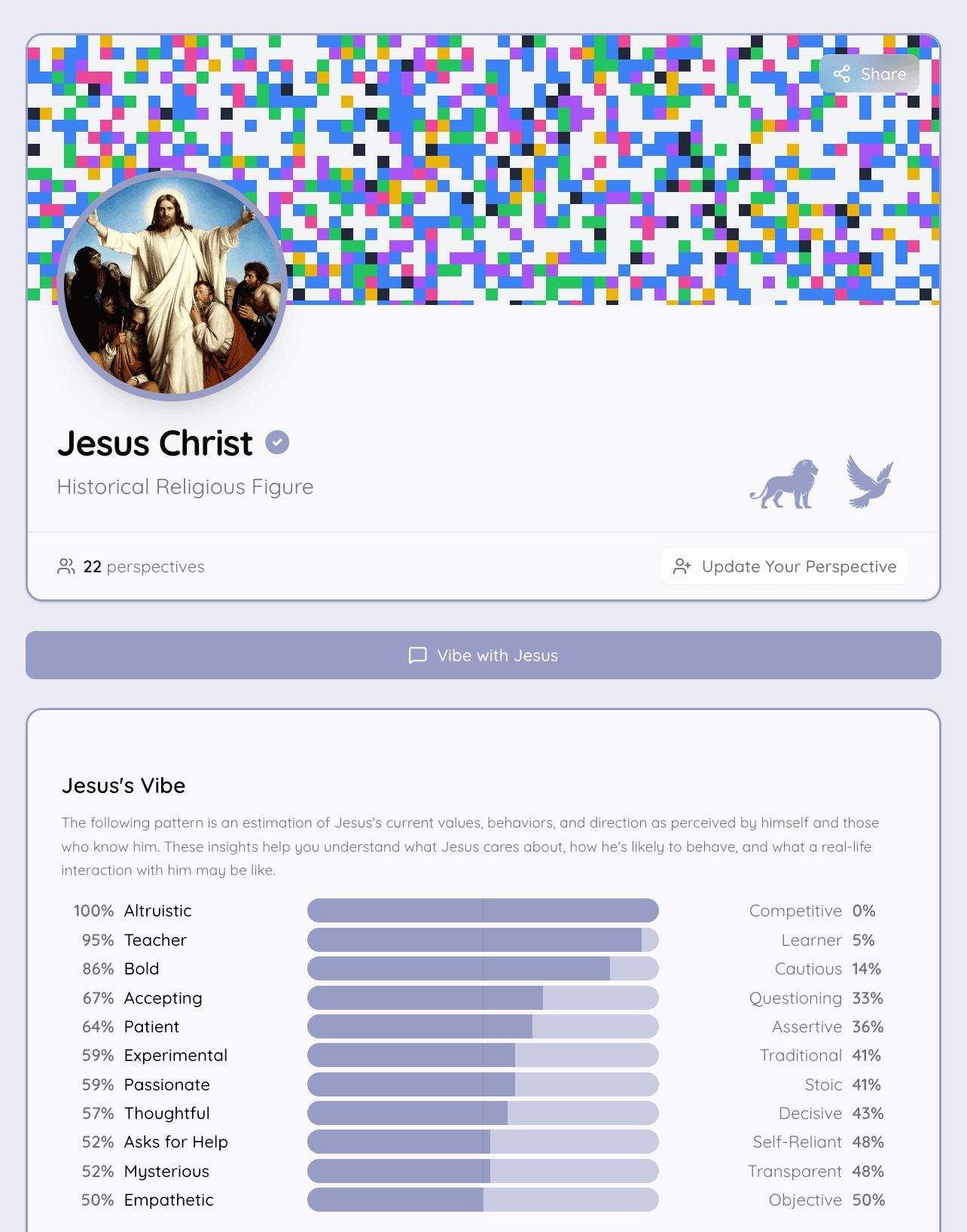
Explore Jesus Christ's full profile on Datababy.
View Jesus' profileThe Scientific Challenge of Jung's Ideas
Despite the enduring influence of Jung's theories, they have faced criticism within the scientific community. Modern psychology often prioritizes experimental measurement, statistical validation, and replicable models. Jung's work, by contrast, relied heavily on symbolic interpretation, mythological analysis, and clinical observation.
Concepts such as archetypes, the collective unconscious, and symbolic religious meaning are difficult to test empirically. As a result, Jung's theories have had tremendous cultural and clinical influence but have not always been widely adopted within experimental psychology.
Yet the absence of measurement has long been one of the main reasons Jung's insights have remained philosophically compelling but scientifically difficult to operationalize.
The Opportunity for Measurement
This challenge opens an interesting possibility. If Jung's theories describe real psychological dynamics, then modern data tools could potentially make them measurable.
This is where systems like Datababy introduce a new dimension. Datababy focuses on measuring behavioral polarities within individuals and teams. Instead of relying solely on subjective introspection, the platform collects structured feedback through forced-choice surveys that map how traits distribute across different polarities.
For example, individuals may naturally over-index in certain behavioral traits while under-indexing in others. In Jungian terms, these underdeveloped or suppressed traits can resemble elements of the shadow. They represent parts of the personality that are not being fully expressed or integrated.
Rather than framing shadow work purely as introspective exploration, Datababy treats it as something that can be observed through patterns of behavior. By measuring how traits appear across multiple observers, the system can identify areas where an individual's identity may be disproportionately concentrated on one side of a polarity.
In effect, Datababy provides a behavioral mirror that reveals where a person's unused potential may lie — translating one of psychology's oldest concepts into something measurable and actionable.
From Symbolic Psychology to Behavioral Data
Jung's work emphasized that psychological growth requires integrating neglected parts of the personality. However, he lacked tools to quantify this process.
Modern behavioral measurement allows us to approach this challenge differently. When multiple observers report consistent patterns about a person's behavior, these patterns can reveal blind spots, overused strengths, and underdeveloped capabilities.
In this way, the measurement of polarity distributions can function as a practical indicator of where shadow integration may be needed. Instead of relying solely on symbolic interpretation, individuals can now examine data-driven feedback about how they show up in real environments.
- •Overused strengths that crowd out complementary traits — a direct parallel to shadow suppression.
- •Behavioral blind spots revealed through the gap between self-perception and observer feedback.
- •Underdeveloped polarities that signal where unused potential may be dormant.
- •Progress over time as individuals begin to consciously develop neglected sides of their behavioral profile.
This approach does not replace Jung's theory. Rather, it extends it. Jung provided the conceptual framework: the psyche contains hidden aspects that must be integrated to achieve wholeness. Datababy introduces the possibility that these dynamics can be observed through behavioral data, making psychological development more measurable and actionable.
A Bridge Between Depth Psychology and Modern Data
Carl Jung's ideas about the Christ archetype and shadow integration remain powerful because they describe a universal human process: the movement toward wholeness. The Christ archetype symbolizes the integration of opposites within the psyche, while shadow work represents the courage required to face what has been hidden.
For decades, these insights lived primarily in the realms of philosophy, religion, and clinical psychology. Today, emerging behavioral measurement tools offer the possibility of grounding some of these ideas in data.
By identifying where individuals overuse certain traits and underdevelop others, systems like Datababy provide a practical method for recognizing the parts of the self that may remain unseen. In doing so, they bring Jung's insights into a new era — where psychological growth can be explored not only through introspection but also through measurable patterns of behavior.
Modern behavioral intelligence platforms may represent a bridge between Jung's depth psychology and the empirical demands of contemporary science — making the inner life legible in ways Jung himself never had access to.